


Acoustical Consulting in the Modern Workplace: Why Integrated Design Matters
Key Takeaways:
- Acoustical consulting is the discipline that designs how a space sounds, covering what gets absorbed, what gets transmitted, what gets heard, and what gets masked.
- The decisions that shape a workplace’s acoustics are usually made by other disciplines first. The acoustician’s job is to translate those decisions into acoustic outcomes that work for the people in the room.
- Good acoustic performance comes from specific, measurable targets, not from generic general applications of acoustical products and materials. NC levels, STC ratings, and speech privacy class are the language of the work.
- The cost of fixing acoustic problems in design is a coordination item. The same fix after a building opens is a renovation.
- Acoustical consulting is one strand of our broader Building Experience practice
Unless you have an acoustical consultant on a project, a ceiling gets specified in a workplace design for what it looks like, what it costs, and how it integrates with the lighting and mechanical layout above it. Acoustic performance is rarely the deciding factor. The same is true of the mechanical equipment selected for the space, the wall assemblies between offices, and the materials chosen for the floor and the furniture. Each of those decisions carries acoustic consequences that arrive later, after the building is occupied and people have started noticing what the space sounds like.
A room’s acoustic behavior is largely set by architectural decisions written into the design well before any acoustical specification is. If an acoustical consultant is not brought in until the end of design or into construction, those decisions are already settled, and the work shifts from designing for acoustic outcomes to mitigating what the building is going to do anyway.
What Acoustical Consulting Is
Acoustical engineering covers several subdisciplines: architectural acoustics, environmental noise control, aeroacoustics, audio consulting, and ultrasound among them. Newcomb & Boyd’s practice sits inside architectural and environmental acoustics, focused on the conditions inside the buildings people work, learn, and gather in.
In a workplace, those four functions translate into a few familiar outcomes. People in private offices can take a confidential call without it being carried. Open-plan zones support focus without requiring headphones. Conference rooms hold conversations that don’t bleed into adjacent spaces. The mechanical system runs without becoming part of the background.
This is the discipline of designing the physical conditions for sound in a space. The work covers four functions that operate together: absorbing sound energy so it doesn’t accumulate in a room, blocking sound transmission between rooms, controlling mechanical noise so HVAC and equipment stay below acceptable levels, and masking residual sound where speech privacy or distraction reduction is needed.
Acoustical consulting uses computational modeling, field testing, certified laboratory test data, and vibration analysis to design and verify those conditions. Learn more about Newcomb & Boyd’s acoustic modeling services.
The Discovery Phase in Acoustical Consulting
Before any treatment is specified, an acoustical engineer’s job is to understand what the space has to do and what it currently does. That work happens in three pieces.
Translating Client Intent into Acoustic Specifications
A workplace project starts with what kind of acoustic experience the building has to deliver, room by room. Confidentiality in private offices, focus in open-plan zones, clear speech in conference rooms with hybrid participants, and calm in arrival spaces each have measurable acoustic conditions behind them, and in discovery, the client’s goals get translated into the specifications that guide the rest of the design.
Modeling, Field Testing, and Vibration Analysis
Three methods do the technical work. Computational modeling simulates how a proposed room will perform before construction, using techniques like raytracing, acoustic mapping, and loudspeaker modeling. Field testing measures existing conditions on renovations and verifies design assumptions during construction. Vibration analysis assesses how mechanical equipment and adjacent occupancies will affect the spaces being designed.
The Team Doing the Work
Newcomb & Boyd’s acoustical consulting is led by credentialed acousticians, including John Garretson, INCE-USA.
Britton Gates, CTS-D, CTS-I, Principal of the Building Experience Studio, draws a distinction the firm holds to on every project:
“There are a lot of consultants on the market who do AV and say, yeah, I also can do acoustics. There are people who are somewhat jacks of all trades, but I truly believe they’re masters of none. When we say we’re doing lighting, acoustics, and AV on a project, it means we have an experienced, dedicated lighting designer, an experienced, dedicated acoustician, and an experienced, dedicated audiovisual consultant working on that project as a team.”
Acoustic Performance Targets for Commercial Spaces
What separates good acoustic design from generic general acoustical applications is the use of specific, measurable targets. The three frameworks below cover most of the work an acoustical engineer does on a commercial project. Each one answers a different question about how a space performs.
NC Levels and Background Noise
NC, or Noise Criteria, describes the acceptable level of background noise from mechanical systems and equipment, measured across the frequency spectrum. The published reference is ANSI/ASA S12.2; the ASHRAE Handbook covers application to HVAC design.
Typical commercial targets:
- Open offices: NC-35 to NC-40
- Private offices and small conference rooms: NC-30 to NC-35
- Boardrooms and executive offices: NC-25 to NC-30
- Lobbies and circulation: NC-35 to NC-45
STC Ratings for Sound Transmission Between Rooms
STC, or Sound Transmission Class, describes how well a wall, floor, or ceiling assembly blocks airborne sound from passing through it. Higher numbers mean more isolation. Demising walls between spaces with different acoustic requirements need to be specified at the right STC level for the conversation that’s expected to happen on either side.
Typical commercial targets:
- Standard office to office: STC 45
- Private office (confidential conversation): STC 50
- Conference room to conference room: STC 50 to 55
- Executive office: STC 50 to 55
NRC and Speech Privacy in Open Plans
NRC, the Noise Reduction Coefficient, describes how much sound a surface absorbs. Ceilings, wall panels, and other absorptive treatments are specified to NRC targets that, in combination with the room’s geometry and the masking system, produce the speech privacy the space needs.
In open plans, the key acoustic metric is reverberation time (RT60), which describes how long it takes sound to decay by 60 decibels after the source stops. Longer reverberation times make speech less intelligible and noise more fatiguing, while shorter times produce a quieter, more controlled environment. The published reference is ANSI/ASA S12.60, which sets reverberation time criteria for various room types. Acoustic ceiling tiles typically run NRC 0.80 to 1.00; stretched fabric wall panels run NRC 0.85 to 0.95; baffles and clouds run NRC 0.85 to 1.00 depending on depth and material.
Acoustic Treatment Strategies for Offices
Once acoustic targets are defined, treatments are chosen to meet them. The work falls into two broad categories: shaping the surfaces and assemblies that determine how sound behaves naturally in a space, and adding ambient sound where speech privacy or distraction reduction is needed.
Absorption and Isolation
Absorption reduces sound energy in a room. In a dropped-ceiling office, acoustic ceiling tiles do most of that work. In an exposed-ceiling environment, the acoustician specifies treatments that absorb sound without restoring the ceiling: suspended baffles, acoustic clouds, stretched fabric systems, spray-applied finishes, or acoustic plaster. The choice depends on the room’s geometry, the aesthetic intent, and the budget.
Brett Gilbert, PE, Principal of Newcomb & Boyd’s Civic and Commercial Studio, frames the exposed ceiling problem directly:
“Acoustics is an often forgotten or overlooked piece that’s actually really important. The ceilings want to be as high as they possibly can be or not there at all. Unless you are very intentional about how the acoustics work with that system, you’re going to have what you don’t want, which is users noticing your systems.”
Isolation is a separate problem. It prevents sound from passing between spaces, and it depends on the wall, floor, and door assemblies more than on what’s added to a room’s surfaces. The acoustician specifies these assemblies to match the privacy expectations of the rooms on either side, with confidential spaces calling for heavier construction than standard office partitions.
How to Specify an Office Sound Masking System
Sound masking adds low-level, broadband sound to a space to reduce the intelligibility of nearby conversations and the perceptibility of intermittent noise. Done well, it sits at the edge of awareness, smoothing the acoustic environment without becoming part of it.
On our projects, the acoustical group typically identifies which areas should receive masking and pairs those recommendations with appropriate isolation components, while our AV group handles the specification and calibration of the masking systems themselves. That specification work is more than buying a product. It involves choosing the right frequency content for the space, calibrating the level so the masking is effective without becoming distracting, and selecting between two system architectures: speakers in the occupied space, tuned by zone, or speakers above the ceiling distributing sound through the ceiling tile. The first option works in exposed ceilings and open plans where the second isn’t possible. The second is simpler in standard dropped-ceiling offices.
The work isn’t finished when the system is installed. Masking has to be calibrated to the room as built, not the room as drawn, which means returning after construction to measure and adjust.
Verification During Construction and Commissioning
Between the issued design and the opening day of a building, a lot of things happen, with products getting substituted in the field, late-stage changes accumulating in ceilings and mechanical routing, and systems calibrated to the room as it was actually built rather than the room as it was drawn. Acoustical consulting continues through that period, with the work shifting from specifying conditions to verifying them.
Two kinds of work happen during this phase.
Catching Acoustic Issues Before They Get Built
During construction, the acoustician reviews submittals to confirm that the products being supplied match what was specified, attends coordination meetings where late-stage design changes affect the acoustic environment, and stays available to the contractor when questions come up in the field. A different ceiling tile than the one specified will perform differently. A mechanical equipment substitution may change the noise contribution. A change in routing for ductwork affects the spaces below.
Donny Walker, PE, RCDD, Partner of Newcomb & Boyd’s Studio 4 and Studio 5, describes why the firm stays engaged through this period:
“The technology is outpacing the development of construction. So we’re having to get more engaged during the shop drawing development and scheduling and making sure the contractor stays on point and getting the project delivered. There’s a lot of hand-holding during the implementation process.”
The work in this period is less about creating the design than about protecting it.
Commissioning the Built Space
After construction, the acoustician verifies that the finished space performs as designed. Background noise levels are measured. Room acoustics and reverberation times are confirmed. Sound masking is calibrated to the room as built. Acoustical isolation is tested where confidentiality is a project requirement. Where the built room differs from the design intent, the acoustician identifies what can still be adjusted before the space opens and what may have to be
Commissioning is the moment the acoustic targets become acoustic outcomes. A project that has been carefully designed and casually verified arrives at the opening with conditions that don’t match what was promised. A project that has been verified through construction and commissioning arrives at the opening ready to support the people moving in.
Post-Occupancy Acoustic Fixes and Their Cost
An acoustic problem caught during design is a coordination item. The same problem caught after a building opens is a renovation. The work involved is meaningfully different, and so is the cost.
What a Post-Occupancy Fix Actually Involves
Once a workplace is occupied, the conditions for changing how it sounds are no longer the conditions of a construction project. People are working in the space. Furniture is installed. Finishes are complete. Adding absorption means returning to a finished ceiling and hanging baffles or clouds where there used to be open structure. Improving wall isolation means opening assemblies that have been painted and trimmed. Adjusting a masking system that wasn’t calibrated correctly means tuning around the disruption of an occupied environment rather than during the controlled conditions of commissioning.
Even small fixes carry overhead that a design-phase change doesn’t. The work has to be scheduled around occupancy. Temporary relocation may be needed for the affected teams. Coordination with facilities, IT, and the building owner adds friction that didn’t exist when the project was still under construction.
Why the Cost Multiplies
The cost of resolving an acoustic issue grows with the stage of the project at which the issue is identified. During schematic design, the change is a coordination item with no direct cost beyond design time. During construction documents, the same change may require redrawing assemblies or rerouting equipment. During construction, it requires field rework on assemblies that are partially built. After move-in, it becomes a renovation with its own permits, contracts, and disruption.
The pattern is well-documented across construction disciplines. The MacLeamy Curve, introduced by architect Patrick MacLeamy in 2004 and incorporated into the American Institute of Architects’ Integrated Project Delivery Guide, illustrates how the cost of design changes increases sharply as a project moves from conceptual design through construction and into post-occupancy, while the ability of those changes to affect project outcomes decreases over the same period. Acoustic fixes follow the same curve. Acoustic fixes follow the same curve.
Acoustic Design by Room Type
A workplace has many rooms doing different jobs. The acoustic targets, treatments, and verification methods covered earlier look different depending on the space. Three room categories cover most of the work in a typical office project.
Open Spaces
Open offices, collaboration zones, and cafés share the same acoustic problem: no walls are available to do the heavy lifting. The acoustician relies on absorption from the ceiling and selected wall surfaces, on geometry that breaks up sight lines and direct sound paths, and on a calibrated masking system that raises the noise floor enough to reduce the intelligibility of nearby conversations. Open offices are the most demanding case, with speech privacy becoming a layered outcome rather than a single specification. Cafés and collaboration zones operate under a deliberately different philosophy, where some reverberation is appropriate to the social character of the space, but absorption is still needed to keep the energy from spilling into adjacent focus zones.
Enclosed Spaces
Private offices, focus rooms, huddle rooms, and conference rooms all exist to contain what happens inside them. Wall and door assemblies are specified to STC ratings that match the privacy expectation, with confidential and high-stakes rooms calling for heavier construction than standard partitions. Absorption inside the room keeps reverberation low enough for clean phone calls and clear hybrid video meetings. Boardrooms and dedicated videoconference rooms carry the tightest standards in this group, because the conversation is being captured and transmitted, and the room is often visible to clients or partners. In those spaces, the AV system and the acoustic design have to be coordinated from the start, with microphone placement, speaker selection, and absorption strategy each depending on the others.
Public Spaces
Lobbies, arrival spaces, and all-hands or event rooms are the architectural front of the building, often with hard surfaces and high ceilings for visual impact. Without acoustic treatment, the same surfaces produce environments where conversation carries across the room and a phone call by the entrance is audible at the elevator. Absorption is specified to keep the ambient environment comfortable for transient occupants and for the conversations happening at reception or in nearby seating. Event spaces add a further requirement: they often double for multiple uses, which means the acoustic design has to support a range of conditions rather than optimizing for one.
A Workplace Project in Practice
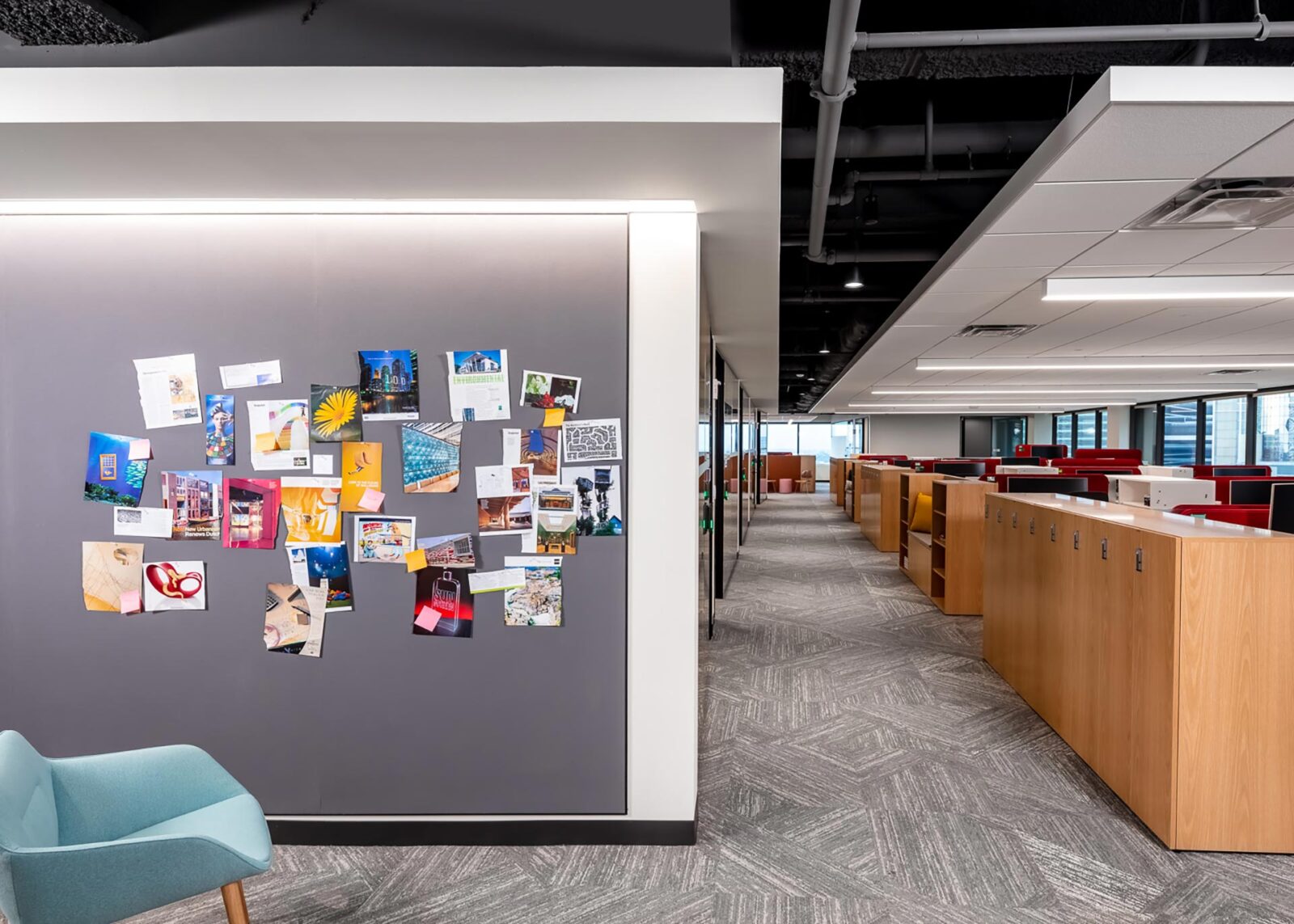
In 2018, Newcomb & Boyd was brought in to design the acoustic environment for the seventh through eleventh floors of the BCG Nexus office in Atlanta. The client has internal acoustic design standards that any new BCG office is expected to meet, with specifications for acoustical privacy and comfort in open and enclosed office areas, meeting space, break areas, and flexible work zones across 44,600 square feet.
The project arrived with a challenge typical of consulting workplaces. BCG’s people spend their days on confidential client conversations, often by phone or video, in spaces that have to support both that confidentiality and a degree of visual openness. The interior design called for demountable furniture walls with full glazing, which preserved sight lines through the office but pushed the acoustic burden onto the systems and materials that could be added around them.
The Design Response
The acoustic design integrated three coordinated strategies. A sound masking system was specified across the floors to raise the ambient noise floor enough to reduce conversational intelligibility between adjacent workspaces, calibrated to the open-plan and enclosed-room conditions in different parts of the building. Wood ceilings and texture changes were coordinated with the interior design so the absorption needed for speech clarity in enclosed rooms came from materials that also served the project’s aesthetic intent. The demountable wall assemblies were specified with the glazing and seal details that supported acoustic privacy without compromising visual openness.
The Newcomb & Boyd team also performed acoustical commissioning after construction, verifying that the finished space met BCG’s internal standards before the offices were occupied.
Why It Worked
The result was a workplace that meets a sophisticated client’s internal design standards while preserving the visual character the interior architect designed. The integration of acoustic design with the architectural and interior decisions, rather than as a layer added after them, is what made the outcome possible. A different sequence, masking specified late, demountable walls chosen without acoustic input, ceilings selected for aesthetics alone, would have produced a space that needed remediation rather than commissioning.
Read more about the BCG Nexus office project
The Outcome of Integrated Acoustical Consulting
The work an acoustical engineer does on a workplace project, from discovery through commissioning, has one goal in the end. The people inside the building are focused on their jobs, the conversations they’re having, the decisions in front of them. The acoustic environment supports that focus by receding from view.
Brett Gilbert puts it directly: “We don’t want our systems to be noticed. It’s almost about hiding. It’s about having things that are effective, that keep users acoustically comfortable, and they’re functional. The AV is working seamlessly, such that they’re not thinking about that sort of thing.”
That standard is harder to reach than it sounds. It requires the acoustic targets, the treatments, the construction-phase verification, and the commissioning calibration to be coordinated with the lighting, AV, and mechanical decisions being made on the same project. When the disciplines work the project as separate exercises, the systems end up announcing themselves to the people in the building. When the disciplines work together from discovery onward, the building disappears into the experience of the people using it.
Must See
Learn more about Newcomb & Boyd’s Building Experience Studio and our integrated approach to acoustic design, lighting design, and audiovisual systems.