


Where Engineering Meets Human Experience.
What if every space you walked into created an experience? From the very first step, you instantly felt the environment, interacted with it, and connected with it.
A room’s acoustic behavior is largely set by architectural decisions made well before any specification is written. The same is true for how lighting reads and how audiovisual systems perform once installed. By the time a space is occupied, the experience it delivers reflects the conversations that happened months or years earlier between the architect, the MEP engineer, and the specialty consultants responsible for each discipline.
Britton Gates, CTS-D, CTS-I, Principal of Newcomb & Boyd’s Building Experience Studio, sees the consequences of those conversations directly: “When building experience isn’t taken into account in design, it almost always leads to rework right after the space starts being used. We’ve been called back to projects where our acoustical recommendations weren’t taken, and the workplace environment was so loud people couldn’t hear themselves think. The cost of those retrofits is much higher than doing it right to begin with.”
Newcomb & Boyd’s Building Experience Studio works to keep that conversation in the room from the start. Our acoustic, lighting, and audiovisual designers sit on one team and coordinate with the MEP engineers, architects, and interior designers from programming through commissioning, across workplaces, training centers, healthcare facilities, higher education, and civic spaces.
Acoustics, Lighting, and AV: Why They Belong in One Design Conversation
We’ve seen exposed ceilings as the dominant aesthetic in office design for the better part of a decade, and they are a useful example of why our acoustician, MEP engineer, and AV designer engage in the same conversation during design. A single architectural decision moves through all three disciplines at once, and the result the client sees depends on whether those disciplines worked the decision together or in sequence.
A dropped acoustical tile ceiling does two jobs, that when removed, the open structure quietly inherits. It absorbs sound energy in the room, holding reverberation time in the range where consonants stay crisp, and it shields occupants from the fans, dampers, and air movement of the mechanical system above it. Remove the ceiling, and exposed deck and ductwork reflect mid- and high-frequency sound back into the space, lengthening reverberation and reducing speech transmission index, while the mechanical noise that was absorbed becomes part of the ambient floor and raises NC and RC levels in the room.
That cascade reaches the AV system before any equipment is selected. Microphone pickup patterns have to tighten to reject reflections, which constrains coverage zones and microphone count. Speaker placement accounts for a shorter critical distance, the point at which reflected energy dominates over the direct signal. Loudspeaker selection and equalization that produce clear voice in a treated room produce a muddy result in an untreated one, and the lighting layout enters the same coordination because the fixtures and structural elements carrying light also occupy the surfaces affecting sound.
How the Experience Studio Works Through Each Stage
Our acousticians, lighting designers, and AV consultants engage from the first conversations about a space and remain in the work through commissioning and operator training. The shape of that involvement shifts as a project moves forward, with each phase building on what the one before it established.
Programming
Before any drawings exist, we are in the room with the client to understand how a space will actually be used. For workplace and training environments, this often means observing people in their current space, interviewing the staff who will use the new one, and surveying executives about overarching goals. The work produces a clear picture of what the space has to do for the people inside it, which becomes the reference point every later decision returns to. On projects where this phase produces an Owner’s Project Requirements document, we build it with the operations team rather than waiting for commissioning to surface it, so the capabilities the client wants are designed in from the start.
Integrated Design
As schematic design begins, our acoustic, lighting, and AV designers join the MEP engineers and the architectural team in a single working conversation. Ceiling treatments are discussed alongside mechanical routing. Fixture layouts are evaluated against sightlines and microphone coverage. On experience-led projects, our team often holds a dedicated specialties project manager who coordinates directly with the architect’s team, so the broader design team has one point of contact for everything our studio brings to the project.
Construction Administration
During construction, our designers review submittals, attend coordination meetings, and stay engaged with the contractor through the build. Technology, acoustic finishes, and specialty lighting often arrive late in the construction sequence and carry tight tolerances. Being present through that period lets us hold the design intent established in programming.
Commissioning and Operator Readiness
Our involvement extends through commissioning and into operator training. The acoustic environment is verified, the AV systems are calibrated to the room they were designed for, and the people who will run the space are walked through how it works. By the time the building opens, the operations team has the building they were planning to operate, ready to use on day one.
Integration In Practice at Insight Global
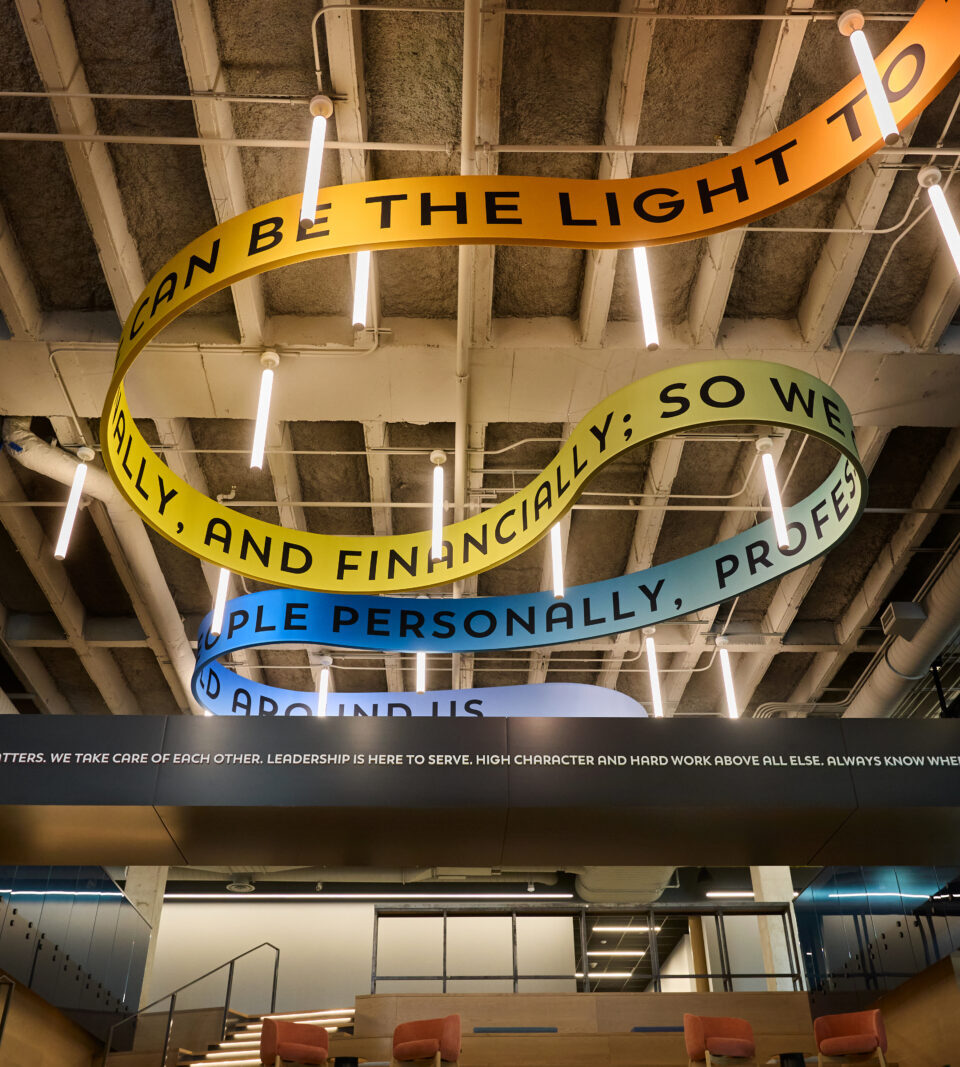
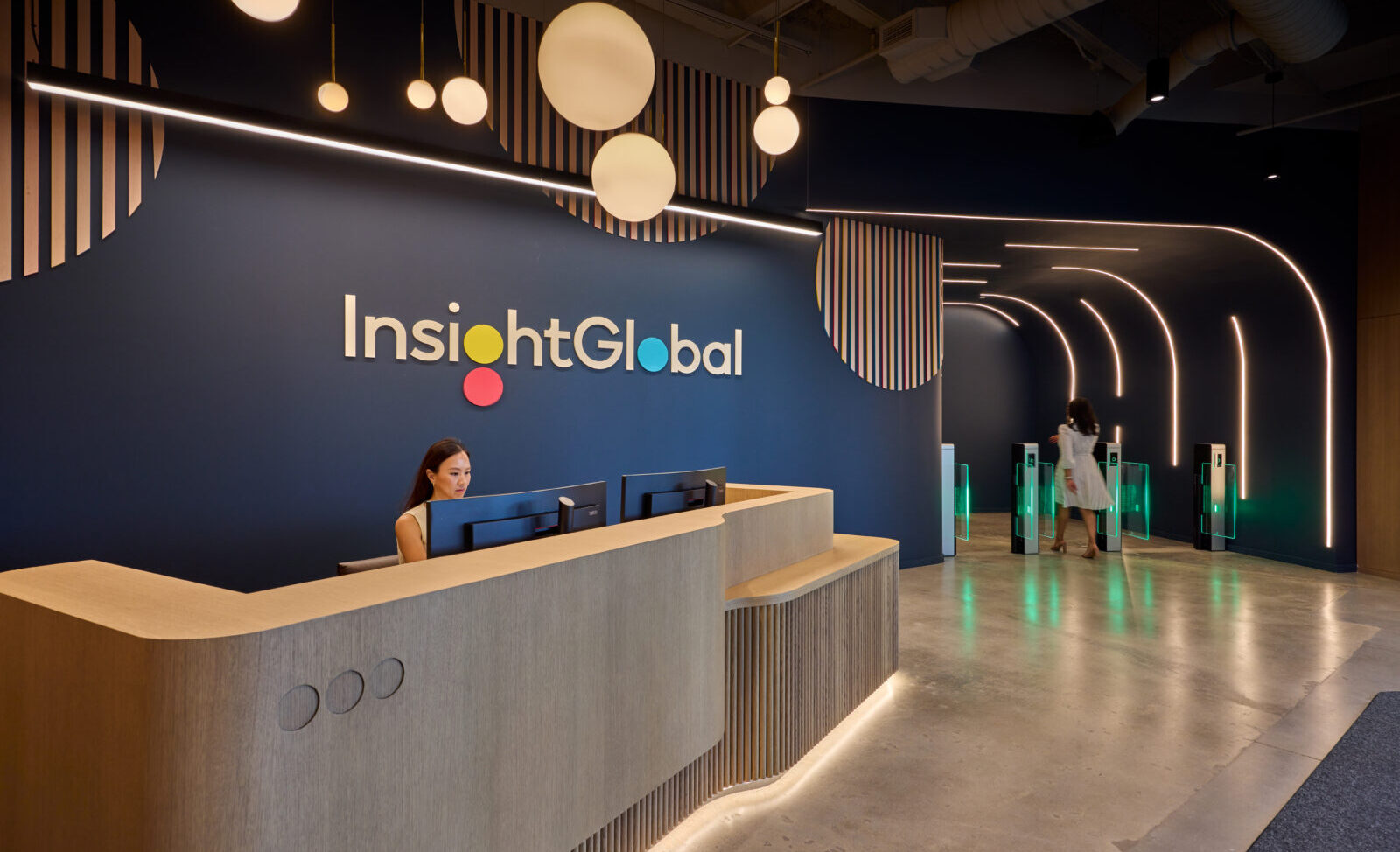
We brought our Building Experience process into Insight Global, an international staffing and professional services company. The company treats those visits as part of how it represents itself. For Campus 244, the leadership wanted a training facility that felt like a destination rather than a building full of conference rooms.
The Client’s Vision: Functional but Memorable
The brief was a Disney World experience that was still a working training center. Leadership wanted thirty-plus rooms that each felt distinct, connected by a single experiential through-line from the entry into the training itself.
Two practical requirements sat underneath the ambition. Training had to support genuine back-and-forth between trainers and trainees, and remote participants had to feel as present as the people in the room. The technology had to deliver both without an operator in every room.
The User’s Needs
Our team sat in on live training sessions in the existing space, interviewed trainers individually, and surveyed them about what worked and what got in the way of the training they were trying to deliver.
The customization level needed for this project shaped the team we brought to it: a lead acoustician for the auditory health of every space, a lead lighting designer for the experiential ambiance, and a lead AV technical designer coordinating systems detail across thirty-plus individually designed rooms, working closely with the interiors group throughout.
The Experience We Built
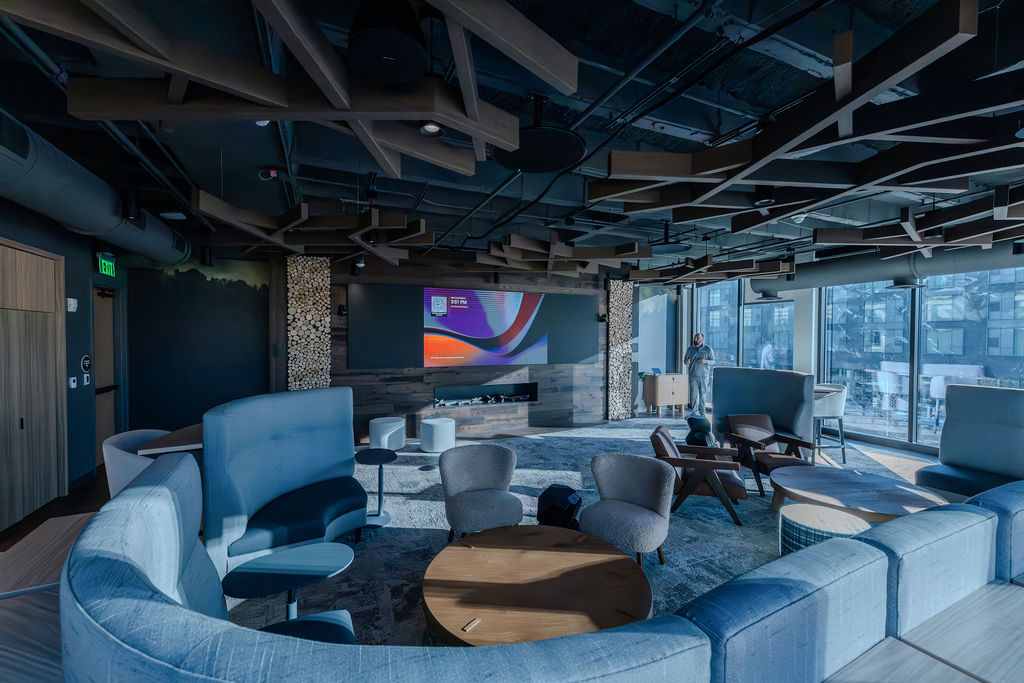
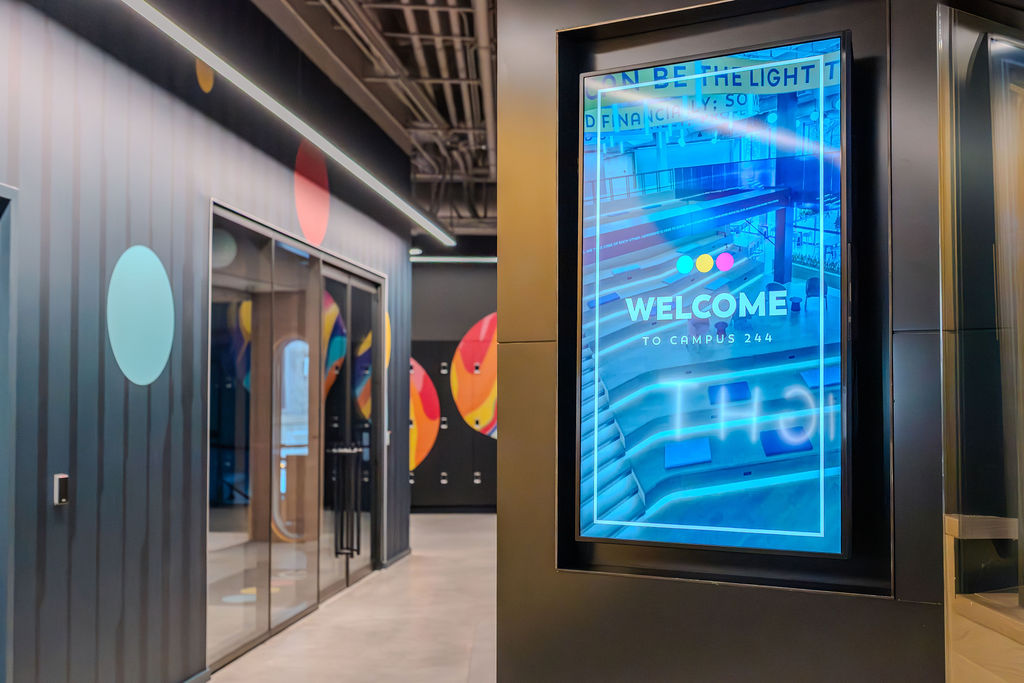
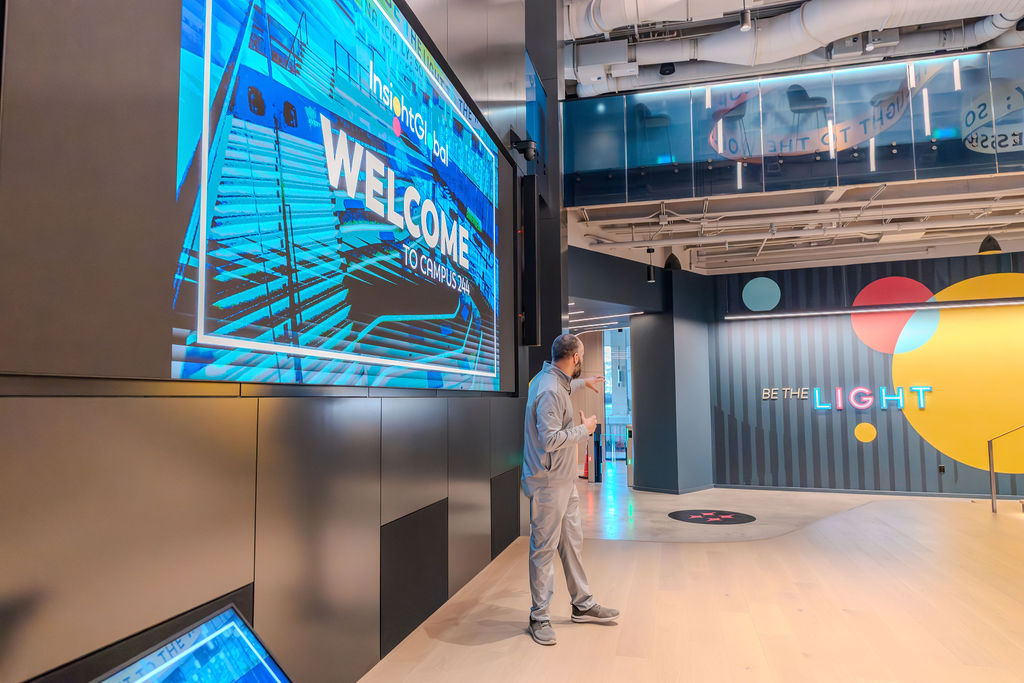
Arrival centers on a communal space with a dual-purpose staircase that doubles as an event venue, anchored by a large LED video wall with integrated speakers and subwoofers. A distributed audio system carries continuous welcome content from the front door through the corridors, transitioning into local training audio as someone enters a room.
Each training room runs on a 32:9 ultrawide direct-view LED video wall that serves as a single branded canvas on arrival and splits into dual screens for presentation. Automatic camera tracking follows the presenter, switching to a side-by-side view when an audience member speaks, while oversize rear displays render remote participants at near life size with audio routed to speakers at their position.
Designing for the User Experience at AbbVie
A different client and a different setting produce different design decisions. At the AbbVie pharmaceutical training center, we designed an environment for healthcare providers learning injection techniques and product protocols. The client communicates the quality of their products through the environment itself, which means every design decision has to reflect that standard.
The Client’s Vision: An Environment That Reflects the Product
AbbVie wanted the arrival itself to do work. By the time a physician reached the training rooms, the brand of the company and the seriousness of the procedures they were about to learn needed to already be established in the space. The training had to follow at the same level, with close-up visibility into procedures performed by experienced physicians and real-time dialogue between presenter and audience.
Designing the Sequence
We designed the visitor experience as a sequence rather than a set of rooms. Acoustics were coordinated across the full path from entry through the immersive media space and into the training environment, so each moment hands off to the next without a visible transition. Our team worked the brand story and the clinical instruction as a single problem, because the credibility of the second depended on the impact of the first.
The Experience We Built
The entry is a digital tunnel with LED strips integrated into the millwork, displaying personalized welcome content for each physician as they walk through. From there, visitors enter a 180-degree floor-to-ceiling immersive video room with high-fidelity audio and low-end bass that tells AbbVie’s organizational story before any instruction begins.
The training rooms are integrated with exam rooms where experienced physicians perform procedures live. Automatic tracking cameras capture the work in close detail, and the AV layout supports real-time questions from the class as the procedure is happening. The technology does significant work, and the people in the room are focused on learning a clinical technique correctly.
The Three Disciplines Behind the Experience
The standard our Building Experience Studio works to is that the people in the room are focused on what they came to do, and the systems supporting them recede from view. We reach that standard by bringing acoustic design, specialty lighting, and audiovisual systems together under one team.
Each discipline carries a distinct technical responsibility, and each one informs the others throughout design.
Acoustics
Sound is central to human centered design and shapes how people feel in a space and how well they are able to do the work they came to do. The acoustic conditions we design for have measurable effects on the people inside a space. The World Health Organization’s Environmental Noise Guidelines document the measurable effects of sustained noise exposure on stress response and cognitive performance, which reinforces what we see in practice: acoustic health is a genuine design priority in any space where people spend significant time concentrating, collaborating, or communicating.
Learn more about acoustical consulting in the workplace
Lighting
Lighting shapes how people feel in a space, how long they can sustain focus, and whether the environment reads as appropriate for what it is being used for. Our designers apply the judgment needed to translate our standards into spaces that serve both the design intent and the people using them.
Donny Walker, PE, RCDD, who works across Newcomb & Boyd’s studio practices, describes it this way: “The lighting and the acoustics and the AV all play into how you experience an environment. They are all working in service of what the architect is trying to build. That is exactly how we approach it.”
Audiovisual Systems
Our goal with every AV system is for it to disappear into the experience. When achieved, we see presenters present seamlessly, hybrid participants are fully present, and people move through the building intuitively. The system supports what is happening in the room, and the people inside it give their full attention to why they came, rather than the systems surrounding them.
In healthcare settings, the Center for Health Design’s review of evidence-based healthcare design research documents how acoustic conditions, lighting quality, and spatial layout directly affect patient outcomes, staff performance, and clinical safety. We bring the same design intent across different markets. This design intent is brought to healthcare and is the same as we bring to workplace, higher education, and civic and cultural environments. Simply because what people experience in a space shapes what they are able to do in it.
Learn more about AV system design
One Team, From Goals Through Commissioning
As Brett Gilbert, PE, Principal of Newcomb & Boyd’s Civic & Commercial Studio, puts it: “When systems are designed in isolation, they will feel to the user that they were designed in isolation.”
Our Building Experience Studio works across workplace environments, healthcare facilities, higher education, and civic and cultural spaces, applying the same integrated approach in each: acoustic design, specialty lighting, and audiovisual systems developed together, in service of the people who will spend time in the rooms we shape.
Must See
Learn more about Newcomb & Boyd’s Building Experience Studio and our approach to acoustic design, lighting design, and audiovisual systems.