


AV System Design as an Integrated Practice, From the Beginning of Design
Key Takeaways
- AV system design works best when the AV team is in the room with acoustics, lighting, and mechanical engineering at the start of design.
- Hybrid meeting room parity is a design outcome, not a technology purchase.
- Integrated AV, lighting, and acoustic teams catch conflicts before construction and hold complex buildings together.
- The AV decisions made on paper shape what a building costs to run for the next decade.
AV system design produces its best results when the AV team is part of the design conversation early, working alongside the acoustic, lighting, and mechanical engineering teams while the building is still a set of drawings. The decisions made in that window shape how the room performs for audio, video, and human attention, and they shape what the building costs to run for the next decade. Newcomb & Boyd practices AV system design this way as part of its Building Experience Studio, where audiovisual, acoustic, and architectural lighting work as one integrated practice. Hybrid meeting parity, camera tracking that follows the speaker, and the operating economics of a building full of training rooms running concurrent sessions all trace back to those early choices.
What is AV System Design?
AV system design shapes how a room handles sound, picture, and the attention of the people in it. It covers the microphones and speakers, the cameras and displays, and the control systems that connect them, so that a presenter can walk in and begin – often without a technician standing by.
Most of those decisions are settled long before any equipment is ordered. An AV designer starts by understanding how a room will actually be used, then designs the systems around that purpose, so the technology supports the people in the space rather than dictating to them.
The Decisions That Determine AV Performance
The work of an AV consultant begins well before anyone picks a microphone or chooses a display. During early design conversations, the AV designer is reading and informing floor plans, sectional drawings, and reflected ceiling plans alongside the rest of the design team, and the contributions made at that stage shape everything that follows.
Ceiling Heights and Microphone Placement
Consider ceiling heights. The pickup pattern of a ceiling microphone array depends on the distance from the array to the people speaking, the angle of the surfaces above the table, and what else is hanging in that ceiling plane. A 9-foot ceiling and a 14-foot ceiling call for different microphone strategies, and a coffered ceiling with pendant fixtures asks a third set of questions entirely. The AV designer raises these questions while the ceiling is still a drawing, when the answer can be coordinated with the lighting designer and the interior designer through a single conversation. By the time construction begins, the microphone placement, the fixture layout, and the acoustic treatment have all settled into the same plan.
Acoustic Surfaces and Speech Intelligibility
The same early coordination applies to acoustic surfaces. Speech intelligibility for the people sitting in the room and for the remote attendees on the call depends on how the room’s surfaces absorb, reflect, and scatter sound. Hard glass walls, carpet selection, ceiling tile, and the location of acoustic panels all feed into how clearly a voice will come through to the far end of a hybrid meeting. The AV designer working with the acoustic team from day one can shape these surfaces toward the audio outcome the client wants, treating room acoustics as a foundation of the design rather than as something to revisit once the room is finished.
The Standards That Guide the Work
This early-phase contribution is the work an AV consultant is positioned to do. AVIXA, the Audiovisual and Integrated Experience Association, sets the professional and technical standards for the AV industry. Its published standards cover display image size and viewing distances, speech intelligibility and audio coverage uniformity, and rack and infrastructure specifications. An AV designer working in early design phases uses these to translate performance goals into measurable criteria: how far can a viewer sit from a display and still read a slide clearly, what percentage of the room falls within the microphone coverage pattern, what camera configurations are needed for the far-end participants to follow who is speaking.
What is a Hybrid Meeting Room?
A hybrid meeting room is built to host two audiences at once: the people sitting around the table and the people joining the same meeting from somewhere else. The room is doing the work of a meeting space and a broadcast studio at the same time, which asks more of it than a traditional conference room ever had to handle.
The goal of a well-designed hybrid room is parity. A remote attendee should experience the meeting at substantially the same quality as someone sitting in the room. That outcome is shaped by design choices made early, and the technology delivers on what the design has already established.
The Microphone, the Speaker, and the Room Are One System
The foundation is symmetric audio. Every voice in the room should reach the remote attendee with clarity, and every remote voice should reproduce in the room loud enough and clear enough that the people sitting around the table treat the remote participant as a peer in the conversation.
Microphone selection is one of the first decisions that shapes whether that happens:
Beamforming arrays are the most common specification for conference and training rooms, covering the table without occupying it and steering digitally as people move.
Table-boundary microphones work well in smaller rooms where ceiling height or surface treatment makes overhead placement less effective.
Gooseneck microphones serve formal settings like council chambers or executive boardrooms, where each seat has a defined role and individual pickup precision matters more than flexibility.
On the loudspeaker side, distributed in-ceiling layouts are standard in many environments, with pendant-mounted or soffit-mounted arrays used where ceiling access is limited or room geometry calls for more directional coverage. Those choices only hold together when the acoustic surfaces are designed alongside them..
How Camera Framing Shapes the Remote Experience
Camera framing carries the visual side. A remote attendee reads the room by watching it, and the camera angle determines what they see and who they can follow. Camera tracking that follows the active speaker gives the remote attendee the same visual access a person sitting in the room has naturally. It also removes the production burden from the space: the room runs without a dedicated operator managing the shot. That combination, audio parity and visual continuity, is what separates a well-designed hybrid room from a conference room with a camera added to it.
The Work of Coordinated Disciplines
When AV, lighting, and acoustics are working the same drawings at the same time, conflicts surface as design conversations rather than field problems, and integrated teams produce two kinds of value: they catch what siloed teams miss, and they hold complex buildings together across every room they contain.
At the Gensler Atlanta office, the interior designer had specified pendant light fixtures for a conference room with an open ceiling. During schematic review, the pendant placement was set to intersect with the microphone sightlines for the room’s AV system. Because the AV designer, the lighting designer, and the acoustic team were in the same conversation, the potential conflict was coordinated early. The fixtures, the microphones, and the room’s acoustic strategy were resolved together with the interior designer before construction began.
For the fuller picture of how acoustics shaped that project, see our companion piece on commercial acoustics.
AV Coordination Across a Full Building
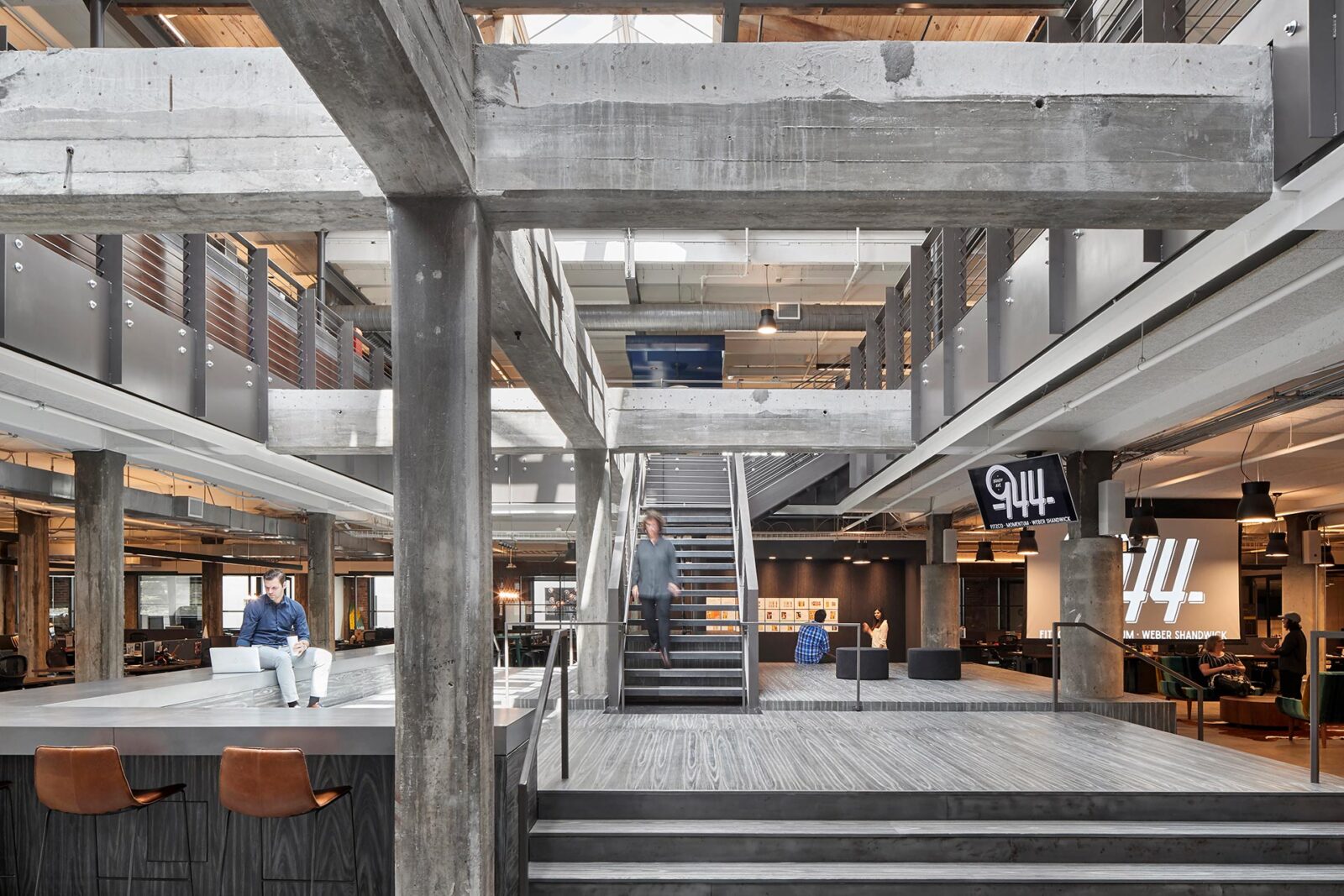
The same approach that catches a single conflict in one conference room is what holds a full headquarters together across every room it contains. A six-story building asks AV to do many things at once. The systems serving a boardroom, a huddle room, an open office, and a 300-person event space are solving different problems, and the design has to hold together across all of them.
RTI International’s headquarters in Research Triangle Park is a building with that full range of room types. Huddle spaces and conference rooms throughout the open office floors are designed for collaboration and videoconferencing with maximum flexibility. A 6,000-square-foot divisible room serves as both a conference center and a banquet hall for 300 attendees. A virtual and augmented reality laboratory carries surround sound and multiple displays, with a dedicated control room built to support technologies still emerging at the time of design. Sound masking runs throughout the workspaces for privacy and acoustic comfort. The project earned LEED Silver certification.
The executive boardroom posed the most specific challenge. Built around a custom 24-person V-shaped table, it required multiple cameras positioned to cover every seat without sightline gaps, and a mix-minus audio reinforcement system that routes each participant’s voice to every other speaker in the room while removing their own signal from their local feed. The result is a natural conversation across a large, unconventionally shaped table where distance and geometry would otherwise work against intelligibility.
Integrated AV Pays Off Over Decades
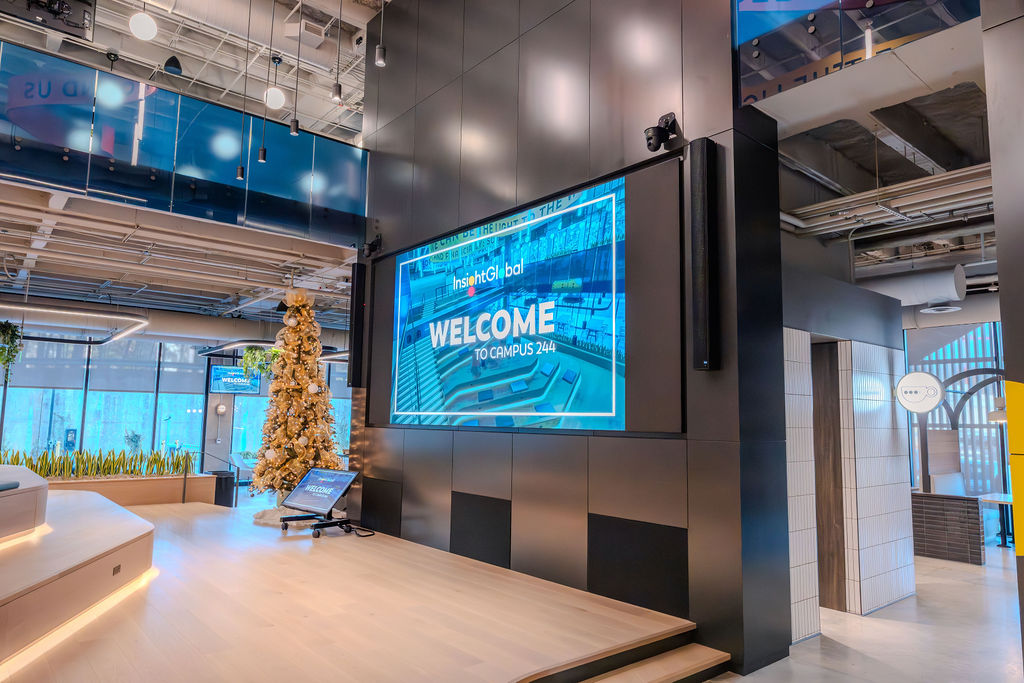
Insight Global‘s corporate training center in Atlanta is where the integrated approach reaches its fullest expression. The client wanted a building that felt functional and intentional at every step, with the experience carried through entry, public corridors, and more than 30 bespoke training rooms as a coherent thread.
The Research Behind the Design
Our team sat in on live training sessions in the client’s existing space, surveyed trainers about how they actually used a room, and interviewed executives about what the new building was for. That research shaped the design at every level. The communal welcome space anchors around a dual-purpose LED video wall in 32:9 wide format that shows branded content on arrival and converts to presentation mode at the press of a button. A distributed audio system carries a consistent sound environment through every training room, so the experiential thread is reinforced acoustically as well as visually. Inside the training rooms, camera tracking follows the instructor and bidirectional audio keeps the group operating as one.
The Operating Economics of Integrated AV
The operating economics are where the long-term value lives. In a facility with 20-plus training rooms running concurrent sessions, keeping every space performing at the same quality can mean a constant scramble between rooms. Camera tracking, automated room transitions, and intelligent control systems are designed to take that pressure off the people running the facility, so managing a room full of technology feels closer to flipping a switch than running a production
A consistent interface from one room to the next keeps daily operation simple, and systems that hold their settings keep the spaces reliable year after year. The design choices made when a building is still on paper shape what it takes for it to run for the next decade. That is the part of the AV conversation most clients have yet to have, and the part Newcomb & Boyd brings to the table at the start of design.
Where the Technology Recedes
A great building is one people feel rather than think about. The people inside it give their full attention to what they came to do, and the systems around them hold the conditions for that attention quietly. AV system design serves that experience when it joins the design conversation at the start, alongside acoustics, lighting, and mechanical engineering, so the technology lands as part of the architecture itself. The same design choices also shape what the building costs to run for the next decade. That is the work of Newcomb & Boyd’s Building Experience Studio, and the rooms it produces are the kind people walk out of without thinking about the AV at all.
Must See
Learn more about Newcomb & Boyd’s Building Experience Studio and our integrated approach to acoustic design, lighting design, and audiovisual systems.